+91 76785 09500

/

+91 11 4100 XXXX

|

Use the online contact form for enquiries.

|

R-274, Block R, Greater Kailash I, New Delhi

Please confirm visit hours when booking.

|

vital_signs Pediatric Motor Coordination & Dyspraxia Support

Motor Skills Support in Greater Kailash I

Difficulties with movement, coordination or handling everyday materials are worth describing clearly. Explore the observations families can bring to a discussion about motor skills and daily participation.

GK-1 movement therapy area

South Delhi Specialized Facility
PT & OT Synergy
Synchronized Joint Care
Motor Learning
Evidence-Led Neuroplasticity
Child development support
verified_user
Clinical Benchmark Standardized MABC-2 & BOT-2 Testing
GK-I Centre
Medical Foundations & Empathy

Understanding Motor Coordination Differences

Every physical movement requires a complex neural symphony: conceiving the intent, planning the muscle sequence, adjusting to gravity, and interpreting continuous sensory feedback. Developmental Coordination Disorder (DCD) and Dyspraxia are neurological processing variations—not intellectual deficits or physical laziness.
psychology

Motor Planning (Praxis)

The brain’s ability to conceptualize, organize, and execute unfamiliar multi-step physical tasks smoothly without conscious strain.
Ideation & Execution arrow_right_alt
alt_route

Bilateral Integration

Harmonious communication between both cerebral hemispheres to coordinate both hands, or upper and lower body together (e.g., cutting with scissors while holding paper).
Hemispheric Synergy arrow_right_alt
explore

Spatial Awareness

Proprioceptive mapping of the body relative to environmental objects, avoiding doorframes, and maintaining personal boundaries in social spaces.
Internal Body Mapping arrow_right_alt
accessibility_new

Postural Stability

Deep core muscle endurance that holds the torso upright at school desks, freeing cognitive energy for handwriting, listening, and sustained focus.
Core Endurance Anchor arrow_right_alt
Signs Parents Notice

Everyday Observations: Where Support Transforms Daily Life

Children with coordination challenges often mask their stress by clowning around or refusing group sports. Recognizing these signals early brings rapid relief.
draw

Fine Motor & Daily Manipulations

Painful or awkward pencil grasp, messy handwriting despite extensive practice, persistent trouble with school uniform buttons, zippers, shoe laces, or holding spoons securely during family meals.
Impact: Slower classroom copy work & morning distress
directions_walk

Gross Motor Clumsiness

Frequent stumbling, bumping into doorway frames and furniture, bruised shins, an awkward or heavy-footed running gait, and visible difficulty navigating uneven colony footpaths or park terrain.
Impact: Physical safety & playground wariness
pedal_bike

Motor Planning & Sequencing

Significant hurdles learning compound physical activities like pedaling a bicycle, learning swimming strokes, performing jumping jacks, or imitating choreography during school annual day rehearsals.
Impact: Difficulty with multi-stage movement
airline_seat_recline_extra

Postural Endurance & Rapid Fatigue

Persistent slumping over study tables, propping the chin on hands while listening, squirming or sliding off chairs, and asking to be picked up or complaining of body tiredness during short family walks.
Impact: Secondary attention deficits from physical fatigue
sports_baseball

Eye-Hand & Visual-Motor Timing

Trouble catching tossed balls, misjudging throw distance, difficulty cutting along curved craft lines, knocking over glasses of milk while reaching, and challenges tracking objects moving quickly through space.
Impact: Ball sports reluctance & table spills
sentiment_dissatisfied

Emotional Frustration & Play Avoidance

Saying “I hate games” or retreating to sedentary screen time during recess, anxiety when faced with sports periods, low self-esteem among peers, or anger bursts when physical tasks do not work on first attempt.
Impact: Social isolation & defensive withdrawal
Comprehensive Clinical Protocols

Six Pillars of Pediatric Motor Rehabilitation at Jhanak

Our integrated South Delhi practice combines specialized pediatric physical and occupational therapy under one roof, eliminating disconnected care and accelerating coordinated progress.
PILLAR 01 fitness_center

Pediatric Physiotherapy for Core & Balance

Targeted conditioning of the pelvic girdle, spinal stabilizers, and vestibular equilibrium reactions using Swiss balls, tilt-boards, and graded incline climbing to establish an unshakeable foundation for movement.
Focus: Postural endurance & anti-gravity strength
PILLAR 02 edit_note

Occupational Therapy for Graphomotor Precision

Intrinsic hand-muscle activation, web-space stabilization, finger separation, and customized visual-motor tracing drills that convert frustrating pencil drag into fluid, fatigue-free writing.
Focus: Dynamic tripod grasp & scissor handling
PILLAR 03 waves

Sensory Integration for Proprioception

An occupational therapy discussion can consider how movement, touch and the environment affect a child’s daily activities. Describe the task and any discomfort so recommendations can follow an individual assessment.

Focus: Body schema accuracy & force gradation
PILLAR 04 sync_saved_locally

Reflex Integration Therapy

Retained primitive reflexes (like ATNR, STNR, or Moro) can involuntarily hijack motor coordination. Our clinicians systematically integrate these early patterns through gentle rhythmic movements.
Focus: Resolving involuntary neurological locks
PILLAR 05 dry_cleaning

Adaptive ADL & Independence Training

Practical mastery of everyday self-care tasks: unzipping lunch bags, buttoning the school blazer, tying sport shoelaces, bathing, and using cutlery with dignified poise and self-reliance.
Focus: Morning routines & self-efficacy
PILLAR 06 sports_soccer

Social Sports & Playground Readiness

Deconstructing cricket bat swings, football dribbling, badminton racquet grip, and playground tag into joyful micro-skills so your child re-enters peer play without fear of ridicule or hesitation.
Focus: Playground belonging & confidence
The Clinical Roadmap

The Jhanak 4-Step Motor Pathway

We do not offer generic exercise sheets. We build a scientifically measured, individualized trajectory designed around your child’s specific motor neurology.
01

Standardized Motor Baseline

Gold-standard MABC-2 (Movement Assessment Battery for Children) and BOT-2 evaluations pinpointing manual dexterity, balance percentiles, and aiming accuracy.
Duration: 60–90 min Assessment
02

Collaborative Multidisciplinary IEP

Our Senior Pediatric Physiotherapist and Occupational Therapist draft a unified Individualized Education & Therapy Plan with clear 12-week functional milestones.
Tailored Functional Goals
03

Dynamic Sensorimovement therapy area Sessions

Discuss movement goals such as joining play, managing classroom tasks or taking part in daily routines. Ask which assessment and professional input are appropriate for your child.

Weekly Guided Progression
04

Home & School Ergonomics Integration

Direct clinical recommendations for school seating ergonomics, pencil grips, PE adjustments, and caregiver routines that turn ordinary days into therapy boosters.
Continuous Ecological Wrap
Bridging Clinic to Classroom

Delhi School Advocacy & Classroom Accommodations

Children spend the majority of their active movement hours in school. A child who cannot write quickly or gets picked last in sports can quickly experience emotional distress. JHANAK actively coordinates with leading schools across South Delhi (CBSE, ICSE, IB, and Cambridge boards) to ensure your child receives constructive, compassionate accommodation.

Sensible PE Accommodations

We consult with Physical Education teachers to replace high-stakes competition with progressive skill-building drills, allowing children to build stamina without social anxiety.

Classroom Seating & Posture Audits

Recommending footstools, wedge cushions, or ergonomic desk alignments that stabilize the child’s lower core, dramatically improving handwriting attention.

Formal CBSE / Board Exemption Support

When dyspraxia substantially affects writing speed, our formal multidisciplinary clinical assessment reports support requests for additional exam time or scribe allowances.
Child development support
Everyday Home Empowerment

Turning Daily Movement into Non-Competitive Fun

Therapy does not stop when you exit our clinic. These caregiver-tested games build motor planning and proprioceptive feedback right inside your living room.
pets

Animal Walks Across the Hall

Have your child bear-crawl, crab-walk, or frog-hop from bedroom to living room. Animal walks flood the shoulders and hips with deep proprioceptive weight-bearing input, rapidly enhancing core muscle tone.
Targets: Shoulder girdle stability & bilateral timing
weekend

Living Room Cushion Archipelago

Arrange sofa cushions on the floor as “islands” over molten lava. Stepping or leaping from soft surface to soft surface forces dynamic foot ankle adjustments, refining reactive balance and motor planning.
Targets: Dynamic equilibrium & spatial anticipation
local_shipping

Heavy-Work Laundry Express

Invite your child to push a laundry basket filled with bed linens across carpet or marble floors. Pushing resistance acts as an instant nervous system calming mechanism while firing core anti-gravity muscles.
Targets: Joint sensory awareness & emotional grounding
Clinical Leadership

Led by Dedicated Pediatric Specialists

Our clinicians combine extensive hospital experience with neuro-affirming pediatric therapy credentials.
Child development support
Clinical Director

Dr. Prashant Kumar

MPT (Pediatrics), MIAP, Sensory & Motor Specialist

Ask about experience relevant to your child’s movement and everyday participation needs.

Child development support
Lead Occupational Therapist

Occupational therapy consultation

Ask the centre to confirm the relevant details before booking.
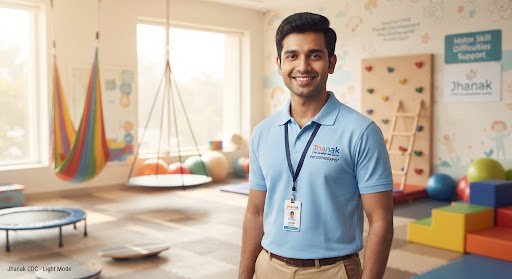
Specializes in severe dyspraxia, fine-motor rehabilitation, graphomotor correction, and sensory processing differences in school-aged children.
Child development support
Senior Pediatric PT

Physiotherapy consultation

MPT (Neurology), Balance & Gait Specialist
Expert in dynamic balance reactions, reflex integration protocols, bilateral coordination, and playground adaptation for hesitant young movers.
Clarity For Parents

Frequently Asked Questions

Answers to the most common questions caregivers ask when noticing coordination and movement hurdles.
While almost all children occasionally trip or drop cups during rapid growth spurts, true Developmental Coordination Disorder (DCD) persists over time and substantially interferes with daily functioning—such as dressing, handwriting, playing sports, or negotiating stairs. Furthermore, a child with DCD does not easily automate these tasks even with repeated instruction. Our standardized evaluations clarify if it is an expected developmental variation or a neurologically based coordination need.

Yes, significantly. Handwriting is not merely a hand function; it relies heavily on core abdominal strength, shoulder stability, visual-motor tracking, and bilateral finger integration. When trunk muscles fatigue quickly, the child bears excessive weight down onto their wrist, causing rapid cramping and untidy letters. By combining core strengthening with fine-motor occupational therapy, we create enduring posture foundations that make handwriting smooth and painless.

At JHANAK, PT and OT operate as two sides of the same coin. Our Physiotherapists focus primarily on gross motor mechanics: building deep core stability, pelvic control, balance equilibrium, and locomotor patterns (running, jumping, kicking). Our Occupational Therapists build upon that postural platform to refine fine-motor manipulations, motor sequencing, sensory-proprioceptive integration, and daily independence skills like dressing and pencil grasp. This synchronized approach delivers much faster results.

Children can be assessed as early as 3 to 4 years of age if early gross motor milestones (crawling, jumping, stair climbing) were delayed or if significant balance issues are apparent. Formal DCD assessments like the MABC-2 are typically standardized for ages 3 through 16. Early intervention between ages 4 and 8 yields the highest neuroplastic returns before negative emotional withdrawal or playground self-consciousness takes root.
Absolutely. Our clinical objective is never to force every child to become an elite competitive athlete, but rather to help them achieve the physical competence, coordination, and confidence necessary to enjoy cycling with colony friends, join school games during recess, and develop a lifelong joyful relationship with physical activity.
Begin Your Child’s Journey

Every Step, Leap & Milestone Matters.

Take the first step toward unlocking your child’s physical confidence. Schedule a comprehensive motor and coordination evaluation with Dr. Prashant Kumar and our specialized clinical team at Greater Kailash I, South Delhi.
location_on
R-274, Block R, Greater Kailash I, New Delhi 110048
call

+91 76785 09500

schedule

Please confirm visit hours when booking.

pin_drop Serving South Delhi & NCR Families

Book Initial Motor Assessment

Confirm appointment timing and the next step directly with the centre.