+91 76785 09500

/

+91 11 4100 XXXX

|

Use the online contact form for enquiries.

|

R-274, Block R, Greater Kailash I, New Delhi

Please confirm visit hours when booking.

|

record_voice_over Pediatric Speech & Communication Care

Speech & Language Delay Support in Greater Kailash I

A concern about communication can involve understanding, expressing ideas or producing speech sounds. This page helps parents organise their observations and discuss whether a speech-language assessment is appropriate.

verified_user

Confirm relevant qualifications with the centre.
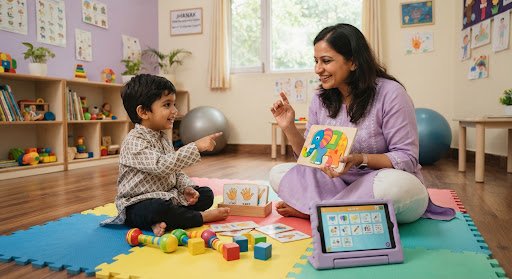
toys
Play-Based Scaffolding
devices_other
Verbal & Multi-Modal (AAC)
Child development support
Greater Kailash I Center

Specialized Child-Led Communication Lab

Multi-sensory acoustic pods designed to reduce anxiety and inspire spontaneous vocal exploration.
Parent Referral Intake 14+ Neurodevelopmental Specialists
hearing
Educational Deep Dive

Speech vs. Language: Demystifying the Difference

Caregivers frequently hear these words used interchangeably, but clinically, speech and language reside in distinct neurological domains. Clear diagnosis dictates whether we target motor production, semantic understanding, or symbolic communication.
psychology_alt
Domain 01

Receptive Language

The internal ability to process, comprehend, and map meaning to spoken words, environmental cues, and instructions.
Key Manifestations:
Difficulty answering “Who / Where” questions
Unable to point to familiar objects when named
Appears to tune out complex directions
Treated via Auditory Scaffolding arrow_forward
chat
Domain 02

Expressive Communication

The external act of encoding thoughts, wishes, emotional states, and needs into verbal or symbolic forms.
Key Manifestations:
Significantly restricted vocabulary for age
Difficulty linking words into phrases
High frustration, crying, or leading parents by hand
Treated via Intentional AAC & Play arrow_forward
auto_stories
Domain 03

Gestalt Processing (GLP)

A neuro-affirming recognition that many neurodivergent children learn language in whole melodic scripts rather than single isolated words.
Key Manifestations:
Scripting dialogue from cartoons or audiobooks
Rich, sing-song intonations with unclear words
Delayed echolalia serving as functional regulation
Treated via NLA Stages 1–4 arrow_forward
spatial_audio_off
Domain 04

Speech & Articulation

The mechanical physical coordination of lips, tongue, palate, and vocal cords to produce intelligible speech acoustics.
Key Manifestations:
Consonant substitutions or sound omissions
Childhood Apraxia of Speech (CAS) motor blocks
Unfamiliar adults unable to parse words
Treated via Oral Placement Therapy arrow_forward
Clinical Benchmark Guide

Speech & Language Red Flags by Age

Early identification between 12 and 36 months preserves vital neuroplastic windows. If your child exhibits any of the flags below, a diagnostic screening is strongly indicated.
12 Months Infant Stage

Expected Norm:

Reciprocal babbling (ba-ba, ma-ma), pointing to indicate interest, responding to the parent’s voice, and shared eye gaze during play.
warning Critical Red Flags:
No reciprocal back-and-forth sounds
Does not react to own name
Absent pointing or waving bye-bye
Scaffold: Joint Attention Focus
18 Months Early Toddler

Expected Norm:

At least 6–10 distinct words used spontaneously with intent, imitating sounds/gestures, and recognizing primary household objects.
warning Critical Red Flags:
Fewer than 6 spontaneous single words
Inability to copy animal sounds or gestures
Extreme distress when trying to express wants
Scaffold: Multi-Modal Expression
24 Months Active Toddler

Expected Norm:

50+ consistent words, constructing two-word combinations (“more milk”, “go park”), and understanding simple two-step instructions.
warning Critical Red Flags:
No spontaneous 2-word phrase construction
Parroting sounds without communicative intent
Struggles to follow commands like “Give ball”
Scaffold: Syntactic Modeling
36 Months Preschooler

Expected Norm:

Describe how your child communicates across the day, including languages, gestures, understanding and speech.

warning Critical Red Flags:

Speech is difficult for unfamiliar listeners to understand

Frequent stuttering, sound blocks, or repetition
Noticeable loss or regression of earlier speech
Scaffold: Intelligibility & Flow
The Multidisciplinary Link

Why Speech Cannot Be Treated in Isolation

At Jhanak, our Speech-Language Pathologists (SLPs) work shoulder-to-shoulder with Sensory Integration Occupational Therapists (OTs). Speech is a full-body neuromuscular output. If a child suffers from vestibular dysregulation, low trunk postural stability, or oral-tactile hypersensitivity, their brain allocates survival energy away from expressive vocabulary.

Postural Grounding

Core stability enables diaphragm control, which drives vocal breath support and phonetic sound power.

Sensory Regulation

A regulated nervous system transitions out of fight-or-flight, unlocking social engagement and conversational attention.
Child development support
Clinical Protocols

Our 4 Core Communication Pillars

tablet_mac

Dynamic AAC Integration

Deploying Augmentative & Alternative Communication—from low-tech visual core boards to high-tech voice-output applications (Avaz, TouchChat, LAMP) to eliminate immediate frustration.

Discuss communication and everyday participation

music_note

Natural Language (NLA)

Honoring Gestalt processors by validating meaningful scripts, acknowledging echolalia as purposeful communication, and systematically guiding the child into Stage 2 mitigations and novel self-generated language.
Marge Blanc NLA Framework
fitness_center

Oral Placement Therapy

Tactile-proprioceptive approaches using specialized bite blocks, horn hierarchies, and straw therapy to build oral muscular strength, jaw differentiation, and consonant clarity.
Targeted Motor Precision
family_restroom

Caregiver Coaching

Parents spend 80+ hours a week with their child; therapists spend 2. We coach caregivers to embed rich linguistic modeling during diaper changes, mealtime, car rides, and park visits.
Daily Home Ecosystem
Case Study • Greater Kailash I Center

Reyansh’s Breakthrough: From Severe Meltdowns to 80+ Spontaneous Phrases
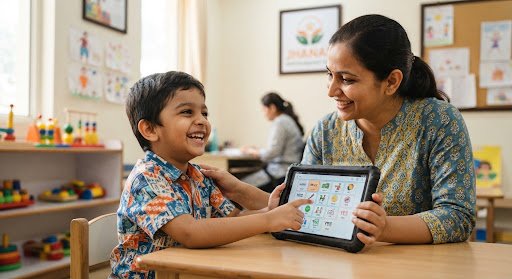
When 3.5-year-old Reyansh arrived from Greater Kailash, he possessed zero functional words. He communicated his daily needs exclusively through high-intensity screaming and hand-dragging. Previous advice was to “wait until he enters school.”
Intake Profile 0 Words High Daily Frustration
Duration 6 Months Joint SLP + OT Track
Modality AAC + NLA iPad Avaz + Modeling
Current Status 80+ Phrases Self-Advocating Child
“Seeing Reyansh tap his AAC screen to say ‘Papa, play car fast!’ and then say the words out loud with a beaming smile transformed our family’s life. Jhanak didn’t just teach speech—they gave our son his voice and self-worth.”
— Mehak & Aditya S., Reyansh’s Parents (South Delhi)
Child development support

Evidence-Based Progress

Review communication through individual goals and real situations. No percentage improvement or completion date is promised.

Caregiver Clarity

Frequently Asked Clinical Questions

Direct, myth-free answers from our clinical speech team.
Definitely not. Waiting is an outdated recommendation. The human brain undergoes its most explosive neuroplastic development between 12 and 36 months. Language delays that go unaddressed often compound into social anxiety, behavior meltdowns, and learning bottlenecks. Early scaffolding before age 3 produces significantly faster and more enduring outcomes.

No, clinical research consistently shows the exact opposite. Augmentative & Alternative Communication (AAC) relieves the extreme cognitive stress of being unable to express thoughts. Because high-tech AAC devices provide instant auditory playback when symbols are tapped, they reinforce neural auditory pathways, frequently catalyzing spoken vocalization rather than delaying it.

Frequency is dictated by the initial diagnostic assessment. Typically, children attend 2 to 3 sessions per week (45 minutes each), often paired with Sensory Integration OT. Crucially, each session includes 10 minutes of direct caregiver training so the therapy continues naturally at home every single day.

Bilingualism does not cause speech delays. Our speech-language pathologists in Greater Kailash are thoroughly fluent in both Hindi and English. We encourage families to speak whichever language feels most emotionally natural and connected, and we configure AAC devices and therapy targets to accommodate dual-language homes seamlessly.

South Delhi Clinic Intake

Book a Comprehensive Speech Evaluation

Confirm relevant qualifications with the centre.

task_alt Confirm appointment timing and the next step directly with the centre.