+91 76785 09500

/

+91 11 4100 XXXX

|

Use the online contact form for enquiries.

|

R-274, Block R, Greater Kailash I, New Delhi

Please confirm visit hours when booking.

|

/
/
Social Skills & Peer Group Therapy
Autumn-Winter Cohort Enrolment Active (GK-I Centre)
psychology_alt PEER RELATIONAL PRAGMATICS & SOCIO-EMOTIONAL FLOURISHING

Social Skills Development in Greater Kailash I

Joining play, communicating preferences and navigating peer activities can look different for every child. Explore social participation goals and ask JHANAK about appropriate individual or group support.

diversity_3
3–5 Peer Ratio
Carefully clinical-matched
record_voice_over
Bilingual & AAC Friendly
Hindi & English supported
favorite

Individual participation goals

Zero coercive masking
Child development support
Session In Session Greater Kailash I Clinic

Shared interests and accessible communication can provide a starting point for enjoyable peer participation.

Led by Senior Speech Pathologist & OT Co-Facilitator
88% Caregiver-Reported

Review participation through meaningful activities rather than promised improvements in a fixed number of weeks.

Our Clinical Benchmark

Connection, Not Compliance: Dismantling the Myth of Social Masking

Social skills support should help a child take part in relationships and shared activities in ways that matter to them. It should not require forced eye contact or hide harmless differences. Start with the child’s interests, communication preferences and experience of the setting.

close Traditional Coercive Training

Teaching Compliance That Leads to Autistic Burnout

do_not_disturb_on Demanding continuous eye contact regardless of intense sensory distress.
do_not_disturb_on Avoid judging participation only by whether a child appears still or makes eye contact. Discuss comfort and accessible communication.
do_not_disturb_on Forcing one-sided neurotypical conversation etiquette that exhausts self-identity.
do_not_disturb_on Ignoring bodily overwhelm to satisfy social conformity markers.
warning Risk: Deep adolescent anxiety, depression, and communication withdrawal.
check_circle The Jhanak Socio-Affirming Way

Cultivating Self-Advocacy, Mutual Empathy & Shared Agency

verified Recognise that listening and engagement may look different for different children.
verified Explore an understandable way to ask for a pause, decline an activity or request help.
verified Use genuine interests as possible opportunities for shared activity rather than enforcing identical social preferences.
verified Equipping peers to co-regulate together during misunderstandings without shame.
verified_user Outcome: Authentic friendships, resilient school navigation, and high self-esteem.
Therapeutic Pillars

Six Essential Spheres of Peer Competency

These areas illustrate possible goals for social skills training. The appropriate focus depends on the child and the setting.

smart_toy

Cooperative Play & Turn-Taking

Explore how a child joins an activity, shares materials or communicates when they want a turn.

Playground & Board Games arrow_forward
forum

Conversational Flow & Pragmatics

Discuss starting a conversation, asking for clarification or using another preferred communication method.

Pragmatic Speech Integration arrow_forward
self_improvement

Emotional Co-Regulation in Groups

Notice when a group setting becomes difficult and how the child can communicate a need for support.

Zones of Regulation Protocol arrow_forward
psychology

Perspective Taking & Theory of Mind

Help children understand differing choices and viewpoints without expecting them to guess every unspoken rule.

Cognitive Social Scaffolding arrow_forward
handshake

Conflict De-Escalation & Compromise

Discuss respectful ways to express disagreement, change an activity or seek adult help.

Restorative Peer Resolution arrow_forward
school

School Yard & Cafeteria Dynamics

Bring examples from break times, clubs or shared meals to identify the setting where support would be useful.

Real-World Ecological Generalization arrow_forward
Cohort Architecture

Discussing Suitable Peer Support

If group support is being considered, ask how age, interests, communication and support needs are taken into account. Confirm whether an appropriate group is currently available.

Tell the centre about environmental adjustments that would help your child participate comfortably.

Tier 01 Ages 3–5

Tiny Explorers

Early Shared Joy & Play

For younger children, a discussion may focus on shared attention, familiar games and communicating preferences.

Key Milestone: Choose an activity goal appropriate to the child rather than a fixed target for minutes of play.
Tier 02 Ages 6–8

Junior Communicators

Playground & Classroom Readiness

School-age children may want help joining a game, understanding choices or asking for clarification.

Key Milestone: A meaningful example might involve completing a shared task with agreed support.
Tier 03 Ages 9–12

Tween Bridge

Nuance & Friendship Depth

Older children may bring questions about friendship, group work or feeling excluded.

Key Milestone: Goals should reflect what the young person wants to understand or participate in.
Tier 04 Ages 13–16

Teen Leadership Circle

Autonomy & Identity Formation

Ask about the ages currently supported and whether individual or group input is suitable for an adolescent.

Key Milestone: Participation goals should respect the young person’s preferences, boundaries and safety.

Our Matching Protocol

Every cohort is curated following rigorous clinical parameters:
1. Sensory Compatibility Discuss the child’s response to busy or quiet settings before considering a group.
2. Communicative Modality Include speech, gestures, pictures and devices when discussing communication access.
3. Shared Passions Shared interests can help identify an activity that feels worthwhile to participants.
Inside The Clinic

An Illustrative Group Session

A group session can have a predictable sequence, but its format and length need confirmation. The following is an illustrative outline rather than a published timetable.

1 00–12 MIN

Welcome Circle & Emotional Gauge

Help participants understand the activity and how to communicate a choice or a need for support.

mood Individual nervous system baselining
2 12–28 MIN

Sensory-Motor Joint Challenge

A suitable shared task may offer opportunities to communicate and make decisions together.

fitness_center Proprioceptive grounding & laughter
3 28–48 MIN

The Collaborative Project Lab

Notice the support needed to join, continue or leave the activity comfortably. The task should match participants’ interests and needs.

extension Active problem solving & compromise
4 48–60 MIN

De-escalation & Parent Briefing

Review the experience and agree how useful observations will be shared with caregivers, with appropriate consent.
family_restroom Caregiver home bridge integration
Child development support

Planning a Suitable Setting

Designed for Sensory Regulation

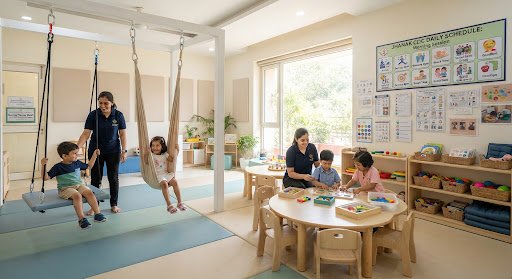
A supportive environment can reduce unnecessary demands. Ask about group size, staffing, access and adjustments rather than assuming photographs establish suitability.

Acoustic Decibel Capped Dual Lead Therapists (OT + SLP) Visual Transition Timers
Parent Inquiries

Frequently Asked Clinical Questions

Questions about peer support, group availability and individual participation goals.

We never place children into groups based solely on chronological age. Every enrollee participates in an individual 45-minute clinical intake assessment with our Senior Speech Pathologist and Occupational Therapist. We evaluate sensory reactivity, communicative style (speaking, non-speaking, AAC device), executive function pace, and specific personal interests (e.g., Lego, trains, manga). We then curate micro-cohorts of 3 to 5 children where communication levels and sensory thresholds complement rather than clash with one another.
Children with selective mutism or intense social apprehension are introduced via our “Graduated Social Bridge” protocol. Often, they begin with 1-on-1 sessions where their therapist builds deep trust. Then, a carefully matched “peer buddy” is introduced for low-demand, parallel sensory play with zero verbal demands. Speech is never forced. We validate non-verbal contributions, written notes, gesture systems, and AAC until the child feels safe enough to expand their communicative repertoire spontaneously.
Absolutely! Jhanak is a pioneer of AAC-inclusive peer groups in Delhi-NCR. We believe all communication is valid. Our therapists explicitly model robust AAC use (TouchChat, Proloquo2Go, Avaz, PECS, core boards) inside group play. Verbal peers in the group are taught multi-modal communication respect: waiting for AAC generation, responding to high-tech voice output, and reading non-verbal bids with absolute parity.
Therapy success requires home-school ecological bridge work. At the end of every weekly session, parents receive a concise “Home-to-Playground Bridge Note” outlining the specific social scripts, problem-solving rubrics, and regulation cues practiced. Additionally, with parent consent, our therapists collaborate directly with school shadow teachers, special educators, and class teachers across prominent schools in South Delhi and NCR to ensure sensory accommodations and peer supports are actively maintained.
how_to_reg Intake Registration

Schedule a Peer Cohort Assessment

Contact JHANAK in Greater Kailash I to ask about social skills support and current individual or group options. Share the activity your child would like help with.

pin_drop Direct Clinic Walk-In

Jhanak Child Development Center

R-274, Block R, Greater Kailash I, New Delhi 110048. Ask about access arrangements before visiting.

Urgent Intake Phone

+91 76785 09500

Peer Group Hours

Confirm current session options and appointment times directly with the centre.

Immediate WhatsApp Response
Message our developmental concierge 24/7