

Clinical Leadership & Speech Pathology
Therapist Profile — Editable Template
Senior Speech & Language Pathologist • AAC & Gestalt Language Specialist
Empowering neurodivergent children to discover their authentic voice, orchestrate multimodal communication, and forge lasting, joyful bonds with family and peers across Delhi-NCR.
Clinical Status
verified
Permanent Clinical License
8+
Years Dedicated Clinical Care
450+
Children & Families Supported
badge
RCI Registration: CRR A-62841
school
AIISH & Manipal Academy Alumna
location_on
GK-I Child Development Center
Clinical Stance
"Communication is not a reward for compliance. It is a fundamental human birthright."
For many parents who walk into our clinic in Greater Kailash, the journey leading up to speech therapy has been stressful and filled with fragmented advice. Children are frequently subjected to standardized testing environments where they are pressured to perform vocal gymnastics, repeat lists of flashcards, or maintain forced eye contact.
My clinical framework is grounded in neurodiversity-affirming, play-partnered methodology. We recognize speech as only one branch of the larger, richer tree of human connection. If a child’s nervous system is overwhelmed, speech motor planning freezes. Hence, every therapeutic intervention begins by establishing deep regulatory safety in collaboration with our occupational therapy team.
Whether a toddler is navigating Gestalt Language Processing (echolalia, scripts, musical intonations) or requires robust dynamic display high-tech AAC (Augmentative and Alternative Communication) systems like Avaz or TouchChat, our commitment is simple: honor their communicative intent immediately, without gatekeeping communication behind verbal speech prerequisites.
psychology_alt
Affirming GLP
Respecting scripted phrases & intoned chunks as meaningful developmental steps to spontaneous language.
tablet
Early AAC
Deploying robust speech output devices early to reduce communication meltdowns and support vocabulary growth.
diversity_1
Parent Coaching
Empowering parents with authentic conversational routines during meals, park trips, and bedtime rituals.
format_quote
“When we replace ‘Say ball!’ with ‘Oh, look how fast it rolls!’, the child shifts from performance anxiety to spontaneous engagement. That emotional shift is where lasting language blooms.”
Pediatric Scope
Areas of Specialized Clinical Practice
Every child’s communication profile is unique. Interventions are calibrated precisely to neurodevelopmental milestones and motor-speech profiles.
devices_other
High-Tech & Low-Tech AAC Integration
Assessment and custom vocabulary configuration for Avaz, Proloquo2Go, TouchChat, and multimodal PODD communication systems tailored to gross/fine motor control.
Motor Access • Dynamic Displays • Core Vocabulary
record_voice_over
Childhood Apraxia of Speech (CAS)
Motor speech planning interventions employing tactile-kinesthetic cues, multi-sensory feedback loops, and dynamic temporal tactile cueing (DTTC) to bridge neurological intent and articulation.
Motor Programming • Syllable Shaping • Prosody
forum
Gestalt Language Processing (GLP)
Systematic scaffolding for natural language acquisition: moving children systematically from whole-script phrases to single word mitigation, grammar generation, and novel conversations.
Echolalia Mapping • Natural Language Acquisition
child_care
Early Communication Scaffolding (18–36m)
Early diagnosis of communication vulnerabilities, joint attention dysregulation, pre-linguistic intentionality, and responsive parental mirroring before functional frustrations escalate.
Pre-Verbal Cues • Shared Attention • Dyadic Play
restaurant
Pediatric Feeding & Oral Motor Therapy
Targeted remediation for food refusal, severe sensory texture aversion, weak mastication, drooling, and swallowing inefficiencies using sensory food-chaining strategies.
OPT Protocols • Texture Desensitization • Swallowing Safety
diversity_3
Social Pragmatics & Peer Relational Play
Coaching school-aged children on conversational reciprocity, understanding perspective-taking, narrative structuring, and advocating self-needs in mainstream classroom setups.
Peer Pods • Self-Advocacy • School Readiness
Credentials & Training
Rigorous Academic Grounding & Continuous Specialization
Clinical excellence requires a relentless synthesis of medical speech pathology and current developmental neuroscience. Ananya actively participates in international peer panels on pediatric language disorders.
workspace_premium
Confirm relevant qualifications with the centre.
Top-tier clinical training encompassing neurogenic speech conditions, pediatric developmental delays, and evidence-based assessment matrices.
verified
Confirm relevant professional registration
Fully accredited clinical licensure adhering to Indian statutory medical practice standards and ethical governance.
psychology
Confirm training relevant to the proposed service
Advanced competency in diagnosing, analyzing, and supporting stage 1 through stage 6 gestalt language development.
soup_kitchen
Oral Placement Therapy (OPT) Level 1 & 2 Trained
Targeted tactile intervention for muscle memory, jaw stability, lip closure, and tongue elevation for speech clarity.
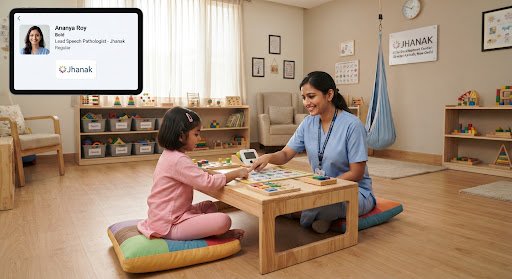
Clinic Standards
Greater Kailash I Speech & AAC Suite
Ask about the facilities and arrangements relevant to your visit.
Multidisciplinary Synergy
Why Speech Therapy at Jhanak Operates as an Integrated Ecosystem
Language cannot flourish in isolation. Ananya coordinates weekly case consults with Jhanak’s full clinical team to align sensory regulation, postural control, and speech formulation.
vital_signs
Co-Care with Dr. Prashant Kumar
If vestibular or proprioceptive dysregulation is present, Dr. Prashant’s Sensory Integration (OT) plan precedes or accompanies speech. A grounded body produces confident vocalization.
Sensory Regulation Match
arrow_forward
accessibility_new
Pediatric Physiotherapy Alignment
Trunk support, diaphragm stability, and head control are vital for sustained breath stream and voice resonance. Physiotherapists assist with seating posture during table AAC interactions.
Postural Core Stability
arrow_forward
psychology
Child Psychology & Behavioral Health
Collaborating on non-coercive reinforcement, emotional co-regulation during communicative frustration, and anxiety management for children entering formal school admissions.
Emotional Well-Being
arrow_forward
Step-by-Step Transparency
Your Child's Comprehensive Speech Evaluation Process
Designed to be stress-free, engaging for your child, and fully enlightening for caregivers.
01
30m
Caregiver Intake & History
An in-depth, unhurried parent discussion regarding pregnancy, developmental milestones, gestural habits, sensory triggers, and daily communication friction points.
Stage: Intake & Case Context
02
45m
Play-Led Assessment
Ananya engages the child in organic play routines using toys, bubbles, books, or devices to assess receptive abilities, motor speech imitation, and communicative intent.
Stage: Observation & Dynamic Testing
03
Panel
Multidisciplinary Review
Clinical consensus meeting with our Occupational Therapists and Clinical Psychologists to cross-reference sensory, motor, and speech findings for cohesive care.
Stage: Internal Clinical Consensus
04
45m
Debrief & 90-Day Roadmap
A comprehensive written evaluation with measurable, functional milestone targets, therapy frequency recommendations, and targeted home practice guides.
Stage: Action Plan Handover
Knowledge for Parents
Therapist Profile — Editable Template

AAC Literacy
• 8 min read
Will an AAC Device Stop My Child From Speaking? Busting the Biggest Myth
Clinical research definitively shows multimodal speech tools actually jumpstart spoken language development by eliminating vocal production anxiety and frustration.

Home Strategies
• 5 min read
10 Everyday Home Play Routines That Naturally Trigger Joint Attention
How simple bathtime games, grocery sorting, and pause-and-wait music routines can deliver more speech value than 3 hours of rote electronic flashcard drill apps.
Clarity For Families
Frequently Asked Questions
Confirm the available professional’s role and qualifications directly with the centre.
No. This is one of the most persistent myths in pediatric care. Decades of clinical peer-reviewed research consistently prove that Augmentative and Alternative Communication (AAC) supports verbal development rather than hindering it. When a child can reliably tap an icon to communicate their urgent need, their cortisol levels drop and social frustration recedes. That reduction in stress frees neural pathways to experiment safely with oral speech without pressure.
The old philosophy of “wait and see until age 4 or 5” is clinically outdated. If a child by 18 to 24 months is not utilizing gestures (pointing, waving), does not respond consistently to their name, or has fewer than 10–20 intentional communicative tokens, an early intervention screening is strongly indicated. Early brain neuroplasticity makes interventions under age 3 dramatically more effective and far less labor-intensive.
Absolutely. In fact, caregiver involvement is foundational to our philosophy. While there may be specific developmental moments where 1:1 clinician interactions help focus on an unfamiliar task, parents are active co-participants. You will learn the exact pause-and-wait pacing, gestural scaffolding, and conversational modeling techniques to replicate throughout the week at home.
Most children begin with 2 sessions per week (45 minutes each), combined with weekly structured caregiver coaching. For children navigating intensive Motor Speech Apraxia protocols or complex AAC programming, 3 sessions may be advised in the initial 6–8 week stabilization block. We periodically re-evaluate goals every 90 days to scale frequency as independence improves.
event_available
Direct Clinical Intake
Confirm the available professional’s role and qualifications directly with the centre.
Take the first definitive step toward unlocking your child’s voice. Connect directly with our clinical intake coordinator to reserve an unhurried, neuro-affirming speech assessment.
verified
Comprehensive Written Report
verified
Multidisciplinary Consensus
call
Immediate Care Line